HOW TO STOP REACTING SO EMOTIONALLY
Understand what’s really happening when you feel anxious, hurt, angry or thrown off—and what to do BEFORE overthinking, people-pleasing, defensiveness, shutting down or emotional reactions take over.
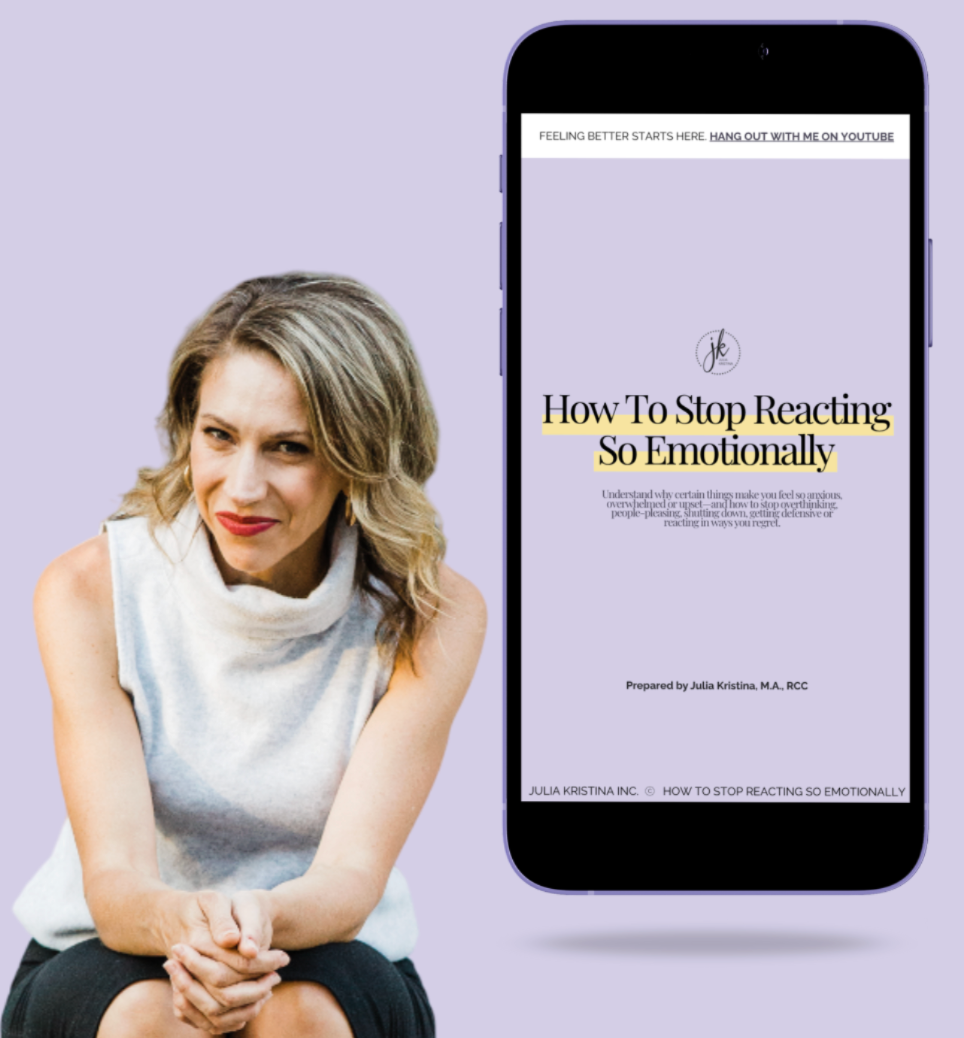
Get the free practical self-guide from Julia Kristina, M.A., RCC
Send me the Guide
- Someone's tone changes.
- Someone criticizes you.
- Someone you care about seems distant.
- Someone is disappointed in you.
- You feel ignored, misunderstood, unappreciated or rejected.
And suddenly something inside you shifts.
- You start questioning yourself.
- Replaying the conversation.
- Trying to figure out what they meant.
- Wanting to explain yourself and fix it.
- Defend yourself.
- Pull away.
- Make them understand
Or say something you later wish you'd handled differently.
And sometimes the hardest part is what happens afterward.
You know you don't want to keep reacting this way... but you don't quite know how to stop it.
Maybe you're tired of doubting yourself every time someone is unhappy with you.
Maybe you're tired of carrying conversations around in your head for hours.
Maybe you're tired of shutting down when you actually want closeness.
Or becoming defensive or angry when what you really want is to feel heard and understood.
If you keep thinking, “Why does this affect me so much—and why can't I handle it differently?” this guide will help you start answering that.
Yes, send me the free guide

WHY DO CERTAIN THINGS HAVE SO MUCH POWER OVER HOW YOU FEEL?
Maybe someone you care about seems irritated with you.
Your partner says something that feels critical.
Your adult child doesn't respond the way you'd hoped.
A family member makes a comment that hits a sensitive spot.
Your boss seems disappointed.
Someone misunderstands you.
Part of you may know there could be another explanation.
But your mind and body are already reacting.
Did I do something wrong?
Why are they treating me like this?
Do they even care how I feel?
Am I being rejected?
Should I say something?
Should I explain myself?
Why can't I just let this go?
And before you know it, what happened outside of you has started changing what's happening inside of you.
Then that can change how you show up.
You get defensive.
You say too much.
You say nothing.
You try to keep everyone happy.
You pull away.
You become resentful.
You snap.
Or you spend the rest of the day questioning yourself.
And sometimes that creates even more of the thing you didn't want in the first place:
tension, distance, resentment or disconnection.
Here's the part that most people miss:
Your reaction usually didn't begin with the reaction.
Something happened in between.
Your mind interpreted what happened.
It gave it meaning.
And that meaning influenced what you felt—and what you wanted to do next.
Once you learn how to catch that missing piece, your reactions start making a whole lot more sense.
More importantly...
You finally have somewhere useful to intervene BEFORE the reaction takes over.
SEND ME THE FREE GUIDE
Because here's the truth:
The thing isn't always the thing.
This is one of the most important things I teach:
The thing ABOUT the thing is often the thing.
Because we don't only react to what happens.
We also react to what we believe what happened means.
They don't respect me. I'm not important. I've done something wrong. They don't care. I'm being rejected. I'm not good enough.
And those meanings can get created so quickly that we don't even realize it's happening.
We just feel the anxiety. The hurt. The anger. The defensiveness. The self-doubt. The urge to fix it. Explain. Prove our point. Withdraw.
Or DO SOMETHING.

CREATED BY JULIA KRISTINA, M.A., RCC
Therapist, coach and psychology educator helping people understand the patterns behind anxiety, overthinking, people-pleasing, self-doubt and emotional reactions
—so they can feel calmer, clearer, more confident and more secure in themselves—and show up that way in the relationships that matter most.
Free. Practical. Yours to keep and come back to whenever you need it.
SEND ME THE FREE GUIDEGet Instant Access
FREE. INSTANT. NO OVERWHELM.
Yours to keep and come back to whenever you need it.